Case Study: How a Compression Stocking Aid Can Help Maximise Independence and Dignity

3 minute read
Tom Rogers
Written by Tom Rogers
George Powney
Reviewed by George Powney
Case Study: Compression Stocking Aid
Skip to section

Recovering after surgery can make everyday tasks surprisingly difficult. Activities that once seemed routine, such as getting dressed or applying cream to your legs, may become challenging when bending is restricted.

This real-life case study shows how the right daily living aids helped one woman regain some independence and dignity in managing these tasks.

Background

Mrs B, aged 76, was referred for reablement support after being discharged from hospital following a dislocated hip replacement.

She had undergone a right hip replacement four years earlier and had experienced multiple dislocations since. She was also awaiting replacement surgery for both knees.

Mrs B lives at home with her husband and their two dogs. Before her recent hospital admission, she had received informal support from family members to help with some daily activities.

At home, she already used a range of equipment to support her safety, including:

  • A walking frame (Zimmer frame)
  • Stairlift
  • Raised toilet seat
  • Grab rails
  • Riser recliner chair
  • Walk-in shower with shower stool
  • Bed loop
  • Catheter management equipment

Despite these adaptations, her recent hip dislocation meant she had to follow strict hip precautions, making everyday tasks more difficult.

The challenge

When Mrs B returned home, a short-term reablement care package was put in place to help her recover safely.

She received two visits per day, providing support with:

  • Personal care
  • Dressing
  • Applying compression (TED) stockings
  • Breakfast preparation
  • Medication prompts

Within just over two weeks, Mrs B had regained independence with nearly all of these tasks. However, putting on and removing her compression stockings remained difficult because bending to reach her feet could increase the risk of another hip dislocation.

Without an alternative solution, this single task alone could have required an ongoing care package or ongoing support from her husband for a task which she really wanted to manage herself.

Finding the right solution

The reablement team therefore explored whether an assistive device could help.

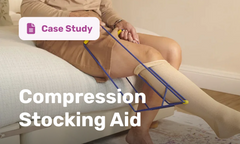
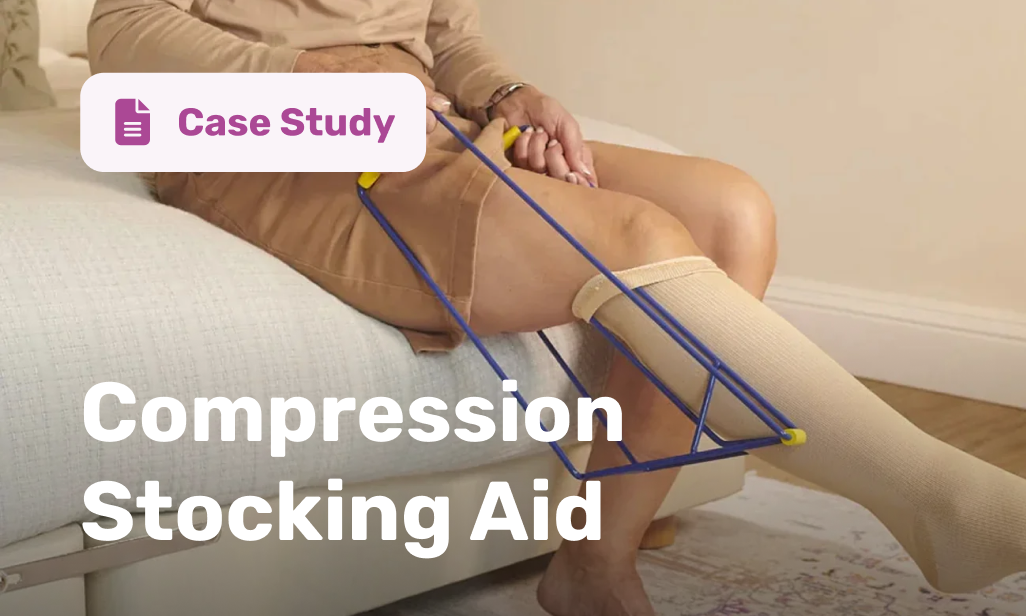
Mrs B was introduced to an Ezy-On Compression Stocking Frame, a simple dressing aid designed to help users apply compression stockings without excessive bending or needing assistance from another person.

With some encouragement and practice, she quickly learned to use the stocking aid independently.

While discussing other ways to make daily life easier, she also identified a long-handled lotion applicator that would allow her to apply cream to her legs without bending, helping her continue to follow her hip precautions safely.

Helping Hand Logo
Helping Hand Ezy-On Compression Stocking Frame for putting on socks or stockings, shown in use.
13701
VAT Relief
Helping Hand

Ezy-On Compression Stocking Frame

(6)

The Ezy-On is a frame that assists with putting on compression stockings and can be used standing sitting or in a lying position. It is useful for people that have difficulties bending down and who have limited movement following procedures such as hip replacements.

  • Makes putting compression stockings on easy
  • Can be used standing, sitting or in lying position
  • Suitable for above and below knee support stockings
£26.58
with VAT Relief
£31.90 Incl. VAT
View Product

The results

The impact was significant.

By using a simple dressing aid, Mrs B was able to:

  • Regain full independence with dressing
  • Continue following her hip precautions safely
  • Reduce her risk of further hip dislocation
  • Avoid relying on carers or family members for a single daily task
  • Build confidence in managing independently at home

Most importantly, she had more dignity in managing this personal care task herself.

Why daily living aids matter

This case highlights how the right assistive equipment can sometimes replace the need for ongoing support with everyday tasks.

Rather than relying solely on care provision, carefully chosen daily living aids can help people:

  • Stay independent for longer
  • Reduce the risk of falls and injury
  • Recover safely after surgery
  • Build confidence with everyday activities
  • Reduce pressure on family carers and health and social care services

Even small adaptations can make a meaningful difference to quality of life.

Supporting independence at home

Every person's needs are different, but finding the right equipment can often make everyday tasks safer and more manageable.

At Manage At Home, we offer a wide range of dressing aids, compression stocking applicators, long-handled daily living products and other practical solutions designed to help people maintain their independence and dignity at home following surgery, illness or changes in mobility.

Tom Rogers
Written by
Tom Rogers
Tom Rogers is Manage At Home’s content marketing specialist with over 6 years of experience in writing for mobility and independence publications.
George Powney
Reviewed by
George Powney
George has 10x years' experience as an Occupational Therapist working across NHS and Adult Social Care. George supports our Southwest Region of the UK with his specialist knowledge of Moving and Handling equipment to support individuals with their daily tasks.

HCPC registered OT
This article is for informational purposes only.

Comments

Leave a comment

Please note, comments need to be approved before they are published.

Related Articles

Case Study - Sara Stedy Image
25/02/2026

Case Study: How the Sara Stedy Can Assist With ‘Proportionate’ Care Delivery and Promote Independence

The Sara Stedy is useful when assisting a person who is struggling to carry out sit-to-stand transfers but still has upper limb strength and trunk control, and is fully weight-bearing. An integral, two-piece paddle seat and castors enable the User to sit between transfers and to be wheeled short distances between seated surfaces and beds.

Read article